Reflection
The Sacred Number 108
A Number That Keeps Returning
If you have spent any time around Vedic prayer, you have probably noticed a number that appears again and again: 108. A mala, the string of beads used for chanting, has 108 beads. The Upanishads are counted as 108. Many sacred names and mantras are recited 108 times. Why does this one number show up so often? The answer reaches into scripture, astronomy, mathematics, and the human heart.
108 in the Scriptures
The Vedic tradition places great weight on the number 108. The Muktikā Upanishad, an ancient text that lists the canonical Upanishads, names exactly 108 of them. These 108 Upanishads are the philosophical heart of the Vedas — the part that explores the nature of the self, the divine, and the path to liberation. By gathering the deepest teachings of the Vedas into 108 texts, the tradition suggests that 108 carries a sense of wholeness, of completeness.
This is not the only place 108 appears. The Vedas speak of many sacred names of the divine, and these are often counted as 108. In prayer, to chant the 108 names is to honour the divine from many angles, each name revealing a different quality of the one formless God that Arya Samaj worships.
The Mala: 108 Beads of Prayer
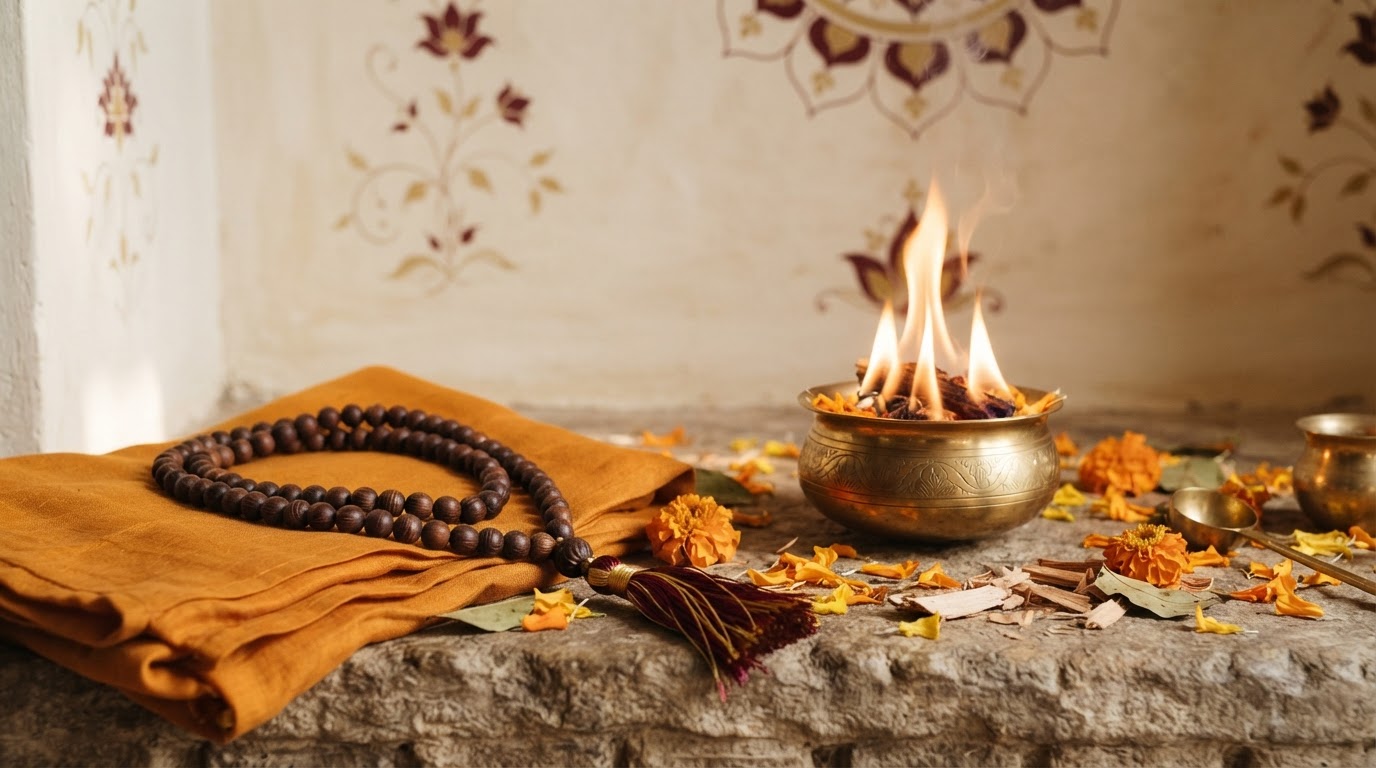
Perhaps the most familiar use of 108 is the mala, the string of beads used for japa, or repeated chanting. A full mala has 108 beads, and the person praying moves one bead for each repetition of a mantra. This is why a mantra is so often chanted 108 times. The beads give the mind something to hold onto, so the heart can stay with the prayer instead of wandering.
There is usually an extra bead, slightly larger, called the meru or guru bead. It marks the beginning and the end of the circle. When the chanter reaches it, they do not cross over it. They turn back. It is a gentle reminder that the journey of prayer is not a straight line but a circle — we return, again and again, to the same sacred centre.
A Number Written in the Sky
Some of the wonder of 108 can be seen by looking up. Ancient observers of the sky noticed a remarkable pattern. The average distance from the Earth to the Sun is roughly 108 times the Sun's own diameter. The average distance from the Earth to the Moon is also about 108 times the Moon's diameter. Because of this, the Sun and the Moon appear almost the same size in our sky — which is why a total solar eclipse is possible at all.
For the Vedic mind, this was not a coincidence. The same number that shapes the prayer beads also shapes the heavens. It suggested that 108 links the small and the vast — the bead in the hand and the sun in the sky. The microcosm and the macrocosm mirror each other.
The Math Behind the Mystery
108 also emerges from simple, meaningful arithmetic. Vedic astrology speaks of 12 signs of the zodiac and 9 planets (navagraha). Multiply 12 by 9 and you get 108. In this view, 108 represents the whole field of cosmic influence — every planet moving through every sign. It is a way of saying: everything is included.
Others point to the structure of the Sanskrit alphabet, which is often arranged in 54 letters, each with a masculine and a feminine form — again giving 108. Whether through the stars, the alphabet, or the planets, the tradition finds 108 wherever it looks for completeness.
A Story of Steady Practice
An old teacher once told his students about a young man who felt his prayers were empty. “I chant the mantra,” the young man said, “but my mind races. I feel nothing.” The teacher handed him a mala of 108 beads. “Do not try to feel anything,” the teacher said. “Just finish the circle. One bead at a time. One breath at a time.” The young man began. Some days his mind wandered. Some days it settled. But he kept finishing the circle. After many months, he told the teacher that the counting had quietly trained his mind. The number had become a path, and the path had led him to stillness.
Why 108 Matters in Daily Life
The beauty of 108 is that it is both grand and practical. It connects us to the cosmos and to the scriptures, yet it also gives us a simple, doable practice. To chant a mantra 108 times takes only a few minutes. Anyone can do it — a child learning their first prayer, a busy parent seeking a moment of calm, an elder settling into the evening. The number turns a vague wish to pray into a clear, complete action.
108 and the Havan
At our monthly Havan, the spirit of 108 is present in the steady rhythm of the mantras and the offerings. Each offering into the sacred fire is a small act of gratitude and letting go. Repeated again and again, these acts build a sense of peace that stays long after the fire has settled. The number reminds us that transformation does not happen all at once. It happens through patient, faithful repetition.
An Invitation to Count Your Way to Calm
You do not need a special day to begin. Choose a mantra you love — even a simple Om. Hold a mala if you have one, or simply count on your fingers. Chant it 108 times. Let the counting be the practice. Let the repetition be the prayer. You may be surprised how such a small number can hold so much peace.
Come and Feel It for Yourself
The best way to understand the power of 108 is to experience it within a community. Join us at the monthly Havan, held every second Sunday from 3 to 6 p.m. at the Hindu Temple of Ottawa-Carleton, 4835 Bank Street, Ottawa. Everyone is welcome, and admission is free. Come as you are, and let the steady rhythm of sacred repetition bring a little more calm into your life.
Join Us This Month
Every second Sunday • 3–6 p.m. at the Hindu Temple of Ottawa-Carleton, 4835 Bank Street, Ottawa. Everyone is welcome and admission is free.